COMPOSTING: BUILDING LIVING SOIL
Next batch available from April 2026 - pre-order now!
christine@eameshorticulture.com
Why is a gardening company composting?
We compost to reduce waste and support sustainable gardening. By processing our own green waste we create high‑quality living soil that improves soil life where we use it or sell it. Composting also lets us accept a wider range of inputs, helping reduce local food waste. Find out how below.
What we are already doing
In October 2025 we added our first bucket of food waste to our hot composter. We now process 15 buckets a week and collect food waste and coffee grounds from 4 local businesses and a community fridge:
WELL NICE FOOD COMPANY
ROOTS: Chesham High Street Café
BREWED BY BOON: Coffee Van
CHESHAM COMMUNITY FRIDGE: saving supermarket food too good to waste.
Chesham Community Fridge | King’s Church Chesham
STRUCTA LLP
Structa LLP | Consulting Engineers
LIVING SOIL
What it does
Our living soil is a natural inoculant that brings beneficial microbes to gardens, beds and planters. Sprinkle it over soil, add organic material or plant a cover crop. Studies and trials show living soil amendments:
-
introduce beneficial microbes
-
stimulate germination
-
make nutrients more available (especially nitrogen and phosphorus)
-
improve water retention and drought resistance
-
aid root emergence
-
increase soil fertility
-
improve soil structure
-
support plant immune systems
How much to use
You do not need to replace all your soil with amendments. Too much can cause overly rapid growth that weakens stems and roots. Small, balanced additions are most effective.
Soil amendment
-
Recommended ratio: 1:4 (one part living soil to four parts existing soil).
-
Example: Mix 5 L of living soil with a 20 L bag of soil to create a balanced growing medium or to treat about 10 m² of ground.
Vermicompost
This is the living soil produced in a worm farm. It is extremely potent as it has passed through the guts of the worms giving it a large dose of beneficial microbes as well as being nutrient rich.
-
Recommended ratio: 1:5 (one part vermicompost to five parts soil).
-
Example: Add 4 L of vermicompost to a 20 L bag of soil.
Living Soil Extract
An extract is simply a way of getting all the good micro life from living soil into water to spray or pour over beds or to kick-start a compost heap of your own! We make these to order as they are best used fresh.
Sowing & Potting
-
Sowing: Coat seeds lightly with living soil and a little rainwater before sowing to give them a microbial boost.
-
Potting mix: Add 5 L of living soil to 15 L of your usual soil or compost for extra resilience and growth power
Compost Demonstration Site
Opening Soon
We would love to inspire you!
We are developing a composting demonstration area to show practical ways to manage food scraps, garden cuttings and other green waste. The site will showcase several composting methods and inspire you to use living soil in gardens, vegetable plots and houseplants. We will update this page when the venue is ready to open to visitors.
Register your interest in a visit
christine@eameshorticulture.com
Meet our composters
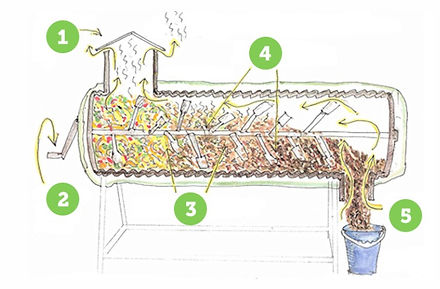
Most of our composters are salvaged and repurposed, keeping useful materials out of landfill. The only new item is our large hot composter, the RIDAN.
RIDAN www.ridan.co.uk
-
Input: Any food waste, cooked or raw, including meat, dairy and bread; balanced with brown material such as wood chip, sawdust or wood pellets.
-
Key feature: Insulated, high‑temperature system; microbial activity heats the mix (up to ~60°C). The process is fast: material is ready after about 7 days, then rests for a few months to mature.
-
Product: Living soil, suitable for soil amendments and extracts.
Classic Dalek
-
Input: Mixed garden waste, dead flowers, coffee grounds and kitchen scraps.
-
Key feature: Low maintenance but slower to break down.
-
Product: Living soil for amendments and extracts.
Green Cone Digester
-
Input: Garden waste, coffee grounds, fruit and veg scraps, plus meat, dairy and bread.
-
Key feature: A buried basket lets soil organisms digest food scraps on site.
-
Product: No separate product; digested material enriches surrounding soil (suitable for in‑bed composting).
Tumbler
-
Input: Mixed garden and kitchen scraps.
-
Key feature: Rotating drum for easy aeration and faster composting; enclosed design reduces pests and odour.
-
Product: Living soil for amendments and extracts.
Worm Farm (Vermicomposting)
-
Input: Small amounts of kitchen waste, eggshells and bedding such as shredded cardboard or leaves.
-
Key feature: Compact and suitable for indoors; needs weekly feeding and frost protection.
-
Product: Vermicompost, a potent amendment for soil and extracts.
Bokashi System
-
Input: All kitchen scraps, including cooked food, meat and dairy.
-
Key feature: Anaerobic fermentation that pre‑digests food waste; can be used indoors.
-
Product: Bokashi liquid rich in nutrients and microbes (dilute 1:100 for watering). Fermented waste is ideal for adding to the RIDAN or a worm farm.
Leaf Litter Cage
-
Input: Fallen brown leaves (shredding or mowing speeds the process).
-
Key feature: Low effort; simple wire fencing contains the pile.
-
Product: Leaf mould, excellent for mulching.
Johnson-Su
-
Input: Fresh materials (grass and hedge cuttings, manure), dry materials (hay, small twigs, woodchip).
-
Key feature: Built for large batches; circular construction with aeration columns gives high airflow so turning is not required.
-
Product: Mature living soil.